
Don't let this picture make you think a thermal feedwater pump is complicated, it is actually very simple. I urge you to spend a little time understanding how a thermal feedwater pump works because the basic concept is used in the systems that follow, and it is easy to understand. I won't explain how an electric feedwater pump works other than to say they use a lot of electricity. Feedwater pumps are used wherever you have a turbine or engine that runs on thermal energy to create electricity. For example, all coal fired, petroleum power plants, and nuclear power plants use feedwater pumps to pump condensed water back into the high-pressure boiler. Feedwater pumps consume roughly two percent of the electricity that the power plant generates. That equates to over 28 million barrels of oil annually just in the U.S alone. In 2024 the world generated 30,850 TWh (terra watt hours). Roughly 70% of that was generated by thermal power plants that use feedwater pumps, making the energy usage of the world's feedwater pumps equivalent to 218 million barrels of oil. One barrel of oil represents 1740 kWh and a world average home uses about 4000 kWh per year. That means that the world wastes enough energy on feedwater pumps to power roughly 100,000,000 homes. That does not account for the 10's of thousands of feedwater pumps used throughout manufacturing and industrial businesses, of which there is no public record of their electricity usage. The feedwater pump's job is to push cool liquid water back into the boiler. It uses a lot of energy to do this because the boiler is typically kept at 1000 °F and 3000 psia (pounds per square inch absolute): in metric that is 538 ℃, 20.7 MPa. This is a great deal of pressure, and the feedwater pump has a lot of work to do to push water in against this enormous pressure. It is no wonder that the feedwater pump uses so much electricity.
These pumps not only use millions of dollars a year in electricity for one power plant, which the power plant could sell, but their initial expenses run into the 10's of millions of dollars to purchase and install. The large feedwater pumps sell for 10 to 30 million dollars each and a big plant uses several of them. For a power plant, feedwater costs are a large part of the plants cost both initially and yearly operating cost. And it turns out there is no need for electric feedwater pumps in the first place! They are a total waste of electricity.
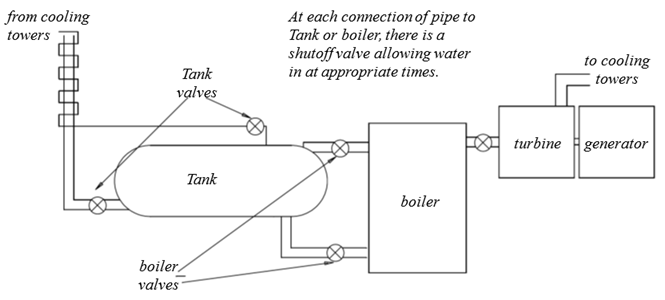
A simple Tank hooked to the boiler and some valves are all that is needed to use a very small amount of the high-pressure steam from the boiler to push the condensed water into the boiler. I call it a thermal feedwater Tank and it uses almost no energy at all. You could say that the amount of energy it uses is insignificant. Take a look at the picture above.
Let's start with a Tank full of water and the boiler full of super-heated steam at the typical 1000°F, 3000 psi (538 C, 20.7 MPa) the boiler likes to be kept at. The two valves of the Tank open electronically (very tiny amount of electricity needed to open a valve). The Tank is now brought to the same pressure as the boiler through both valves. And the water in the Tank will, by gravity, flow into the boiler as the space in the Tank is filled up with the boiler steam. The Tank is now filled with high-temperature, high-pressure steam and that is all the energy that is initially needed to push the water into the boiler (it will be reintroduced into the boiler with the next cycle).
Now the Tank is ready to be filled with the next quantity of 100 ℉ (38 ℃) and atmospheric pressure water that it usually is when it leaves the cooling towers. Now we open the two Tank valves, allowing the water to flow into the Tank by one valve while the super hot steam flows out through the other valve to travel along the condensed feedwater which will preheat the feedwater coming into the Tank. We allow the super hot steam to travel along side the incoming water pipe until the steam loses enough of its energy to the incoming feedwater, to condense back to water at atmospheric pressure and then it can be reintroduced into the incoming feedwater water that enters the Tank. The super-heated steam, condensed, is about to be recycled by coming back into the Tank as condensed water and then back into the boiler with the next cycle.
With the warmer water entering the boiler, less fuel is used to heat the water to super- heated vapor. Therefore, the energy it took from the boiler to push the Tank water into the boiler has been recycled by preheating the cool feedwater. Almost no energy was actually used to run the thermal feedwater pump. The only energy used is the tiny amount needed to operate the open/shut valves and the small amount of heat transfer lost from the insulated Tank and steam pipe that is preheating the cool feedwater. Preheating the feedwater before it enters the Tank, will result in both the feedwater and the high temperature steam vapor each coming to a final temperature of 188 ℉ (87 ℃) before mixing together to enter the Tank. All that electricity used for feedwater pumps is wasted.
See -Appendix for engineering calculations.
Power plant engineers say that the water should be very hot to prevent stress to the boiler. Well, you can preheat the water in the Tank before it enters the boiler using the same fuel that is used in the boiler. It doesn't take much engineering to preheat the Tank water using the boiler energy, so that is not really a problem for engineers.
The electrically driven feedwater pump does not really provide any service other than wasting a tremendous amount of electricity, and therefore the tremendous amount of petroleum it takes to make the electricity and the pollution that goes with it.
An obvious problem would be that the boiler might run out of water to make steam while the Tank is refilling with water. If that is a problem then two Tanks could be used; one could be feeding the boiler while the other was refilling. Power plant engineers can size the Tanks according to the boiler's needs, of course.